

If you’re planning a French immersion stay in Montpellier, timing isn’t a detail—it shapes your daily rhythm, your energy for intensive speaking practice, and even the kind of “French art de vivre” you’ll absorb between lessons. With its Mediterranean climate, the city offers four distinct moods, from springtime walks in L’Écusson to summer nights at Les Estivales, vineyard days during the vendanges, and winter light festivals downtown. Here’s how to choose your season—depending on whether you want calm streets for one-to-one coaching, a cultural marathon, or the full sun-and-sea experience in Occitanie (Hérault).
Key takeaways
- Spring (March–May): 12–22°C, blooming gardens (Jardin des Plantes, Promenade du Peyrou), the ideal balance between sunshine and lower crowds.
- Summer (June–August): often above 30°C, beach + festival rhythm (Montpellier Danse, FISE), and gourmet evenings at Les Estivales.
- Autumn (Sept.–Oct.): a “sweet spot” at 20–25°C, sea at 21–22°C, grape harvest and wine tourism (Château de Flaugergues), plus quieter museums and historic mansions.
- Winter (Nov.–Feb.): 8–15°C on average, a local vibe, Les Hivernales (Christmas market, 100+ chalets) + Cœur de Ville en Lumières, and often lower prices.
- To improve quickly in French: prioritize “in-between” seasons (spring/autumn) to multiply interactions (shops, markets, visits) without climate fatigue.
- Watch out: in summer, heat and crowds can reduce your mental availability for an intensive program—balance it with early-morning schedules.
Spring in Montpellier: the season that makes you talk
Spring is when Montpellier feels like a language classroom with the roof removed: mild air, long walks, and constant chances to speak—without the summer rush.
Blooming landmarks, built-in conversation starters
From March to May, temperatures typically sit between 12°C and 22°C. That range matters more than it sounds: you can spend hours outside without planning your day around heat, rain, or survival-level air conditioning. The Jardin des Plantes—the oldest botanical garden in France—becomes a live dictionary: flowers, scents, labels, and curious locals who actually stop to chat.
Continue up to the Promenade du Peyrou, where the city opens wide. Spring light hits the stone, and suddenly you’re practicing directions, describing views, asking “C’est où, l’Arc de Triomphe ?” (Yes, Montpellier has one: the Arc de Triomphe sits nearby, like a Parisian echo scaled to human size.) In other words, the city gives you prompts—real ones, not textbook dialogues.
Culture first, crowds second
Spring is also when Montpellier’s cultural calendar starts flexing. Theater lovers keep an eye on Printemps des Comédiens, while bookworms gravitate toward La Comédie du Livre in May. Even if you don’t attend every event, the city’s buzz is pedagogical: posters, headlines, conversations in cafés, and the polite chaos of lines and ticket counters. You learn French the way people actually use it—fast, contextual, slightly messy.
L’Écusson on foot: the ideal immersion map
Montpellier’s historic center, L’Écusson, is best discovered when you’re not shoulder-to-shoulder. Spring delivers that sweet balance: generous sunshine, manageable tourist traffic. Walk from the Place de la Comédie—hello, Fontaine des Trois Grâces—and get lost on purpose. This is the right kind of getting lost: you ask for help, you understand half, you confirm the other half, and suddenly you’re speaking.
Concretely, this is also a great season for a one-to-one coaching rhythm: lesson, coffee, walk, repetition, real-life practice. It’s like learning to swim in a calm sea before testing waves.

Summer: when immersion feels like a festival (and sometimes a workout)
June to August is peak season: the city turns outward, social, and loud—in the best way, as long as you pace your energy.
Sea life a few kilometers away
Summer in Montpellier is hot and dry, often exceeding 30°C. The reward is proximity: the Mediterranean coast is about 11 km away, and beach escapes to Palavas-les-Flots become part of your weekly routine. Think of it as a “language lab” with saltwater breaks: you practice French in town, then cool off by the sea, then come back with a renewed brain.
You can also follow the River Lez and its bike-friendly routes. With the Vélomagg network, moving around becomes easier—and movement is underrated for language learning. When you’re cycling to a neighborhood like Port Marianne, you’re not translating in your head; you’re reacting, noticing, and naming things in real time.
Big events, big listening practice
In summer, Montpellier doesn’t whisper—it performs. Major events include Montpellier Danse, the Festival Radio France Occitanie, and FISE (extreme sports). For learners, this is gold: announcements, interviews, street conversations, and the casual slang you won’t meet in formal courses. You’ll hear French at full speed—and you’ll start catching more than you expect.
Les Estivales: the city’s weekly “oral exam”
Every Friday night, Les Estivales take over the Esplanade Charles de Gaulle. Picture wine tastings, local food, and live music under the stars. It’s a bit like stepping into a friendly oral exam—except the goal isn’t perfection, it’s connection. You ask for a recommendation, you describe what you like, you learn the vocabulary of texture and aroma, you toast with strangers. Remember: fluency is often social confidence wearing a language like a jacket.
One practical note for intensive programs: schedule your focused sessions early in the day. In the afternoon, heat can flatten concentration. Protect your brain like an athlete protects their legs.
Autumn: vineyards, museums, and the clearest headspace for progress
September and October are a strategic choice: the city calms down, the weather stays generous, and your attention span comes back online.
Indian summer, real comfort
Early autumn is often described as a “sweet spot.” The sea remains warm—around 21–22°C—while daytime temperatures soften to a comfortable 20–25°C. That means long afternoons of sightseeing without the summer strain. You can do a morning lesson, a midday walk, and a museum visit without feeling like you’ve run a marathon.
Vendanges and day trips into the garrigue
Autumn is also the season of vendanges—the grape harvest. Surrounding vineyards wake up, and wine tourism becomes the obvious weekend plan, especially around places like the Château de Flaugergues. It’s not only about tasting; it’s about vocabulary: terroir, cépages, récolte, élevage. Language sticks when it has a smell.
And beyond the vineyards? Point your curiosity toward the Pic Saint-Loup and the garrigue landscape—dry, aromatic scrubland that defines much of this part of Hérault. You’ll come back with dusty shoes and new words.
Heritage without the hurry: from Musée Fabre to hôtels particuliers
As crowds thin, Montpellier becomes more intimate. The Musée Fabre is easier to enjoy at your own speed, and the city’s hôtels particuliers (aristocratic mansions) feel less like a checklist and more like a discovery. This is also a strong season for cultural deep dives, with events such as the Arabesques Festival and Les Internationales de la Guitare.
You may also hear locals mention Cinémed—a reminder that Montpellier’s cultural identity doesn’t stop when summer ends. In practice, autumn is when many learners feel the fastest gains: more mental space, fewer distractions, and still plenty of life in the streets.
Winter: the quiet season that makes your French feel real
From November to February, Montpellier shifts into an authentic, local tempo—ideal if you want calm focus, fewer tourists, and a city that belongs to itself.
Light, markets, and a city that stays outside
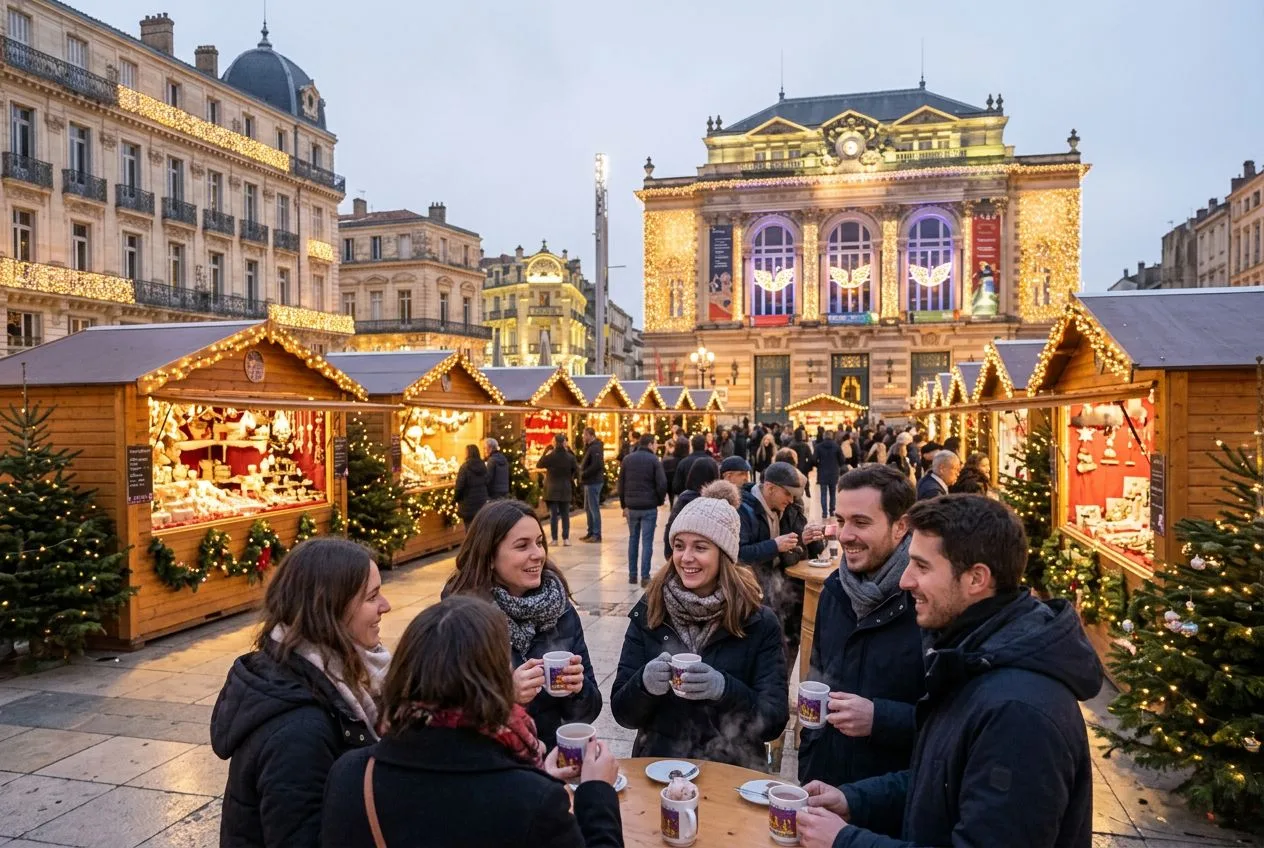
Winters are mild, averaging 8–15°C, and the city boasts over 300 days of sunshine annually. December is the headline month: Les Hivernales, a traditional Christmas market with over 100 chalets, brings people into the streets. Add Cœur de Ville en Lumières, and the center becomes a night walk of projections, glowing facades, and spontaneous conversations. Even in winter, Montpellier still invites you out for “just one more loop” around the Place de la Comédie.
Indoor culture: Mo.Co, museums, and long conversations
When the air cools, indoor spaces become the stage. Montpellier’s art scene stays open, including Mo.Co (Montpellier Contemporain). This is also when museums and exhibitions can feel like private rooms rather than crowded corridors. For language immersion, winter has a hidden advantage: people linger. Conversations last longer in cafés; explanations get more detailed; your ear trains itself on nuance.
Budget-friendly, focus-friendly, and surprisingly social
Winter is often the best season for budget-conscious travelers, with generally lower accommodation rates and full access to indoor attractions like Planet Ocean. But the biggest value might be psychological: less noise, less FOMO, more repetition—the engine of progress. In short, if your goal is serious, intensive practice with one-to-one coaching, winter gives you the mental quiet that turns “I know this” into “I can say this.”


